Sheaves for Visual Encodings and Visual Fusion
Dhruv Meduri (University of Utah), Youjia Zhou (University of Utah), Bei Wang (University of Utah)

Jump to Discussion
Presentation
- Session
- From design spaces to visual design
- Time
- Thursday, Nov 12, 14:00 – 14:12 (US/Eastern) · session 13:00 – 14:30
- Room
- Hall Essex north
- Presenting from
- Boston
Links
Sign in to access the Paper PDF.
Abstract
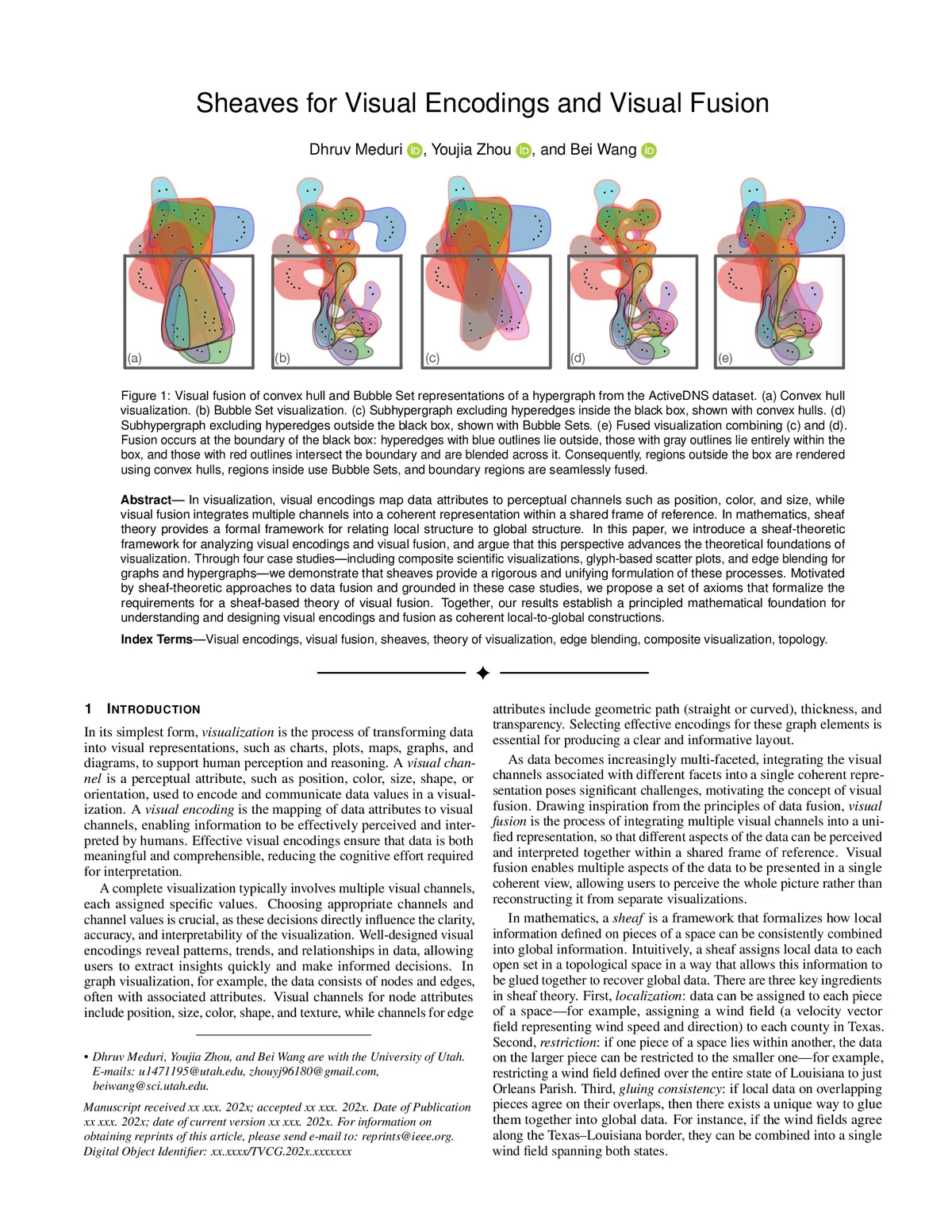
In visualization, visual encodings map data attributes to perceptual channels such as position, color, and size, while visual fusion integrates multiple channels into a coherent representation within a shared frame of reference. In mathematics, sheaf theory provides a formal framework for relating local structure to global structure. In this paper, we introduce a sheaf-theoretic framework for analyzing visual encodings and visual fusion, and argue that this perspective advances the theoretical foundations of visualization. Through four case studies---including composite scientific visualizations, glyph-based scatter plots, and edge blending for graphs and hypergraphs---we demonstrate that sheaves provide a rigorous and unifying formulation of these processes. Motivated by sheaf-theoretic approaches to data fusion and grounded in these case studies, we propose a set of axioms that formalize the requirements for a sheaf-based theory of visual fusion. Together, our results establish a principled mathematical foundation for understanding and designing visual encodings and fusion as coherent local-to-global constructions.
For Practitioners
Data scientists may find this work valuable because it provides a mathematically rigorous, sheaf-theoretic framework for designing visual fusion algorithms. Its generality enables practitioners to develop novel fusion methods across a broad range of data types and application domains.